1 cup organic pumpkin puree
3 cups baby spinach
1⁄2 Bartlett pear, cored
1⁄4 frozen banana
2 Tbsp organic unsweetened cocoa powder
1 Tbsp maple syrup or honey
1⁄4 tsp pumpkin spice
1 cup ice
Enjoy!
"Colorectal cancer is one of the most preventable cancers," said Elisa Bandera, MD, PhD, who served on the World Cancer Research Fund/ American Institute for Cancer Research's Continuous Update Project (CUP) Expert Panel that authored the report. "AICR has estimated that about 45 percent of colorectal cancer cases could be prevented if we all ate more fiber-rich plant foods and less meat, drank less alcohol, moved more and stayed lean. That's over 64,000 cases in the US every year."
Q: What are the risk factors for colorectal cancer?
A: Based on the CUP and National Cancer Institute data, risk factors for colorectal cancer include
Q: How much alcohol did the CUP report find increases the risk of colorectal cancer?
A: The CUP found that risk for colorectal cancer started increasing with less than one serving of alcohol daily. For every 10 grams of ethanol – a standard drink contains approximately 14 grams of ethanol – there was a 10 percent increased risk of colorectal cancer.
Q: How does alcohol increase colorectal cancer risk?
A: The precise mechanisms are not clear but there are many possiblities. Metabolites of alcohol such as acetaldehyde can act as carcinogens. Alcohol also interacts with tobacco, leading to DNA mutations that are less efficiently repaired in the presence of alcohol. Alcohol may also function as a solvent, enabling carcinogenic molecules to move into cells. Also, high consumers of alcohol may have diets low in essential nutrients, making tissues susceptible to carcinogenesis.
Q: How much fiber do I need to get protection from colorectal cancer?
A: The CUP analyses found that every 10 grams of dietary fiber eaten daily linked to a 12 percent decreased risk for men and an 8 percent decreased risk for women for colorectal cancer.
Consuming the recommended amount of whole grains daily had an even stronger protective link. The report found that eating three servings of whole grains daily linked to a 21 percent decreased risk of colorectal cancer.
The 2010 Dietary Guidelines for Americans recommend that women (ages 19 to 50) consume 25 grams of fiber daily and men in the same age group consume 38 grams daily. The Guidelines recommend that half of all grains consumed daily be whole grains, which for many Americans translates to about three servings.
Today, the World Health Organization’s International Agency for Research on Cancer (IARC) named processed meat as a carcinogen. AICR has included avoiding processed meat as one of our recommendations for cancer prevention since 2007. Processed meat (and high amounts of red meat) increase risk for colorectal cancer.
Here’s our statement on the WHO report.
Both organizations found that for processed meat, even small amounts eaten daily – 50 grams or 1 small hot dog – increases risk for colorectal cancer by 18% compared to eating none.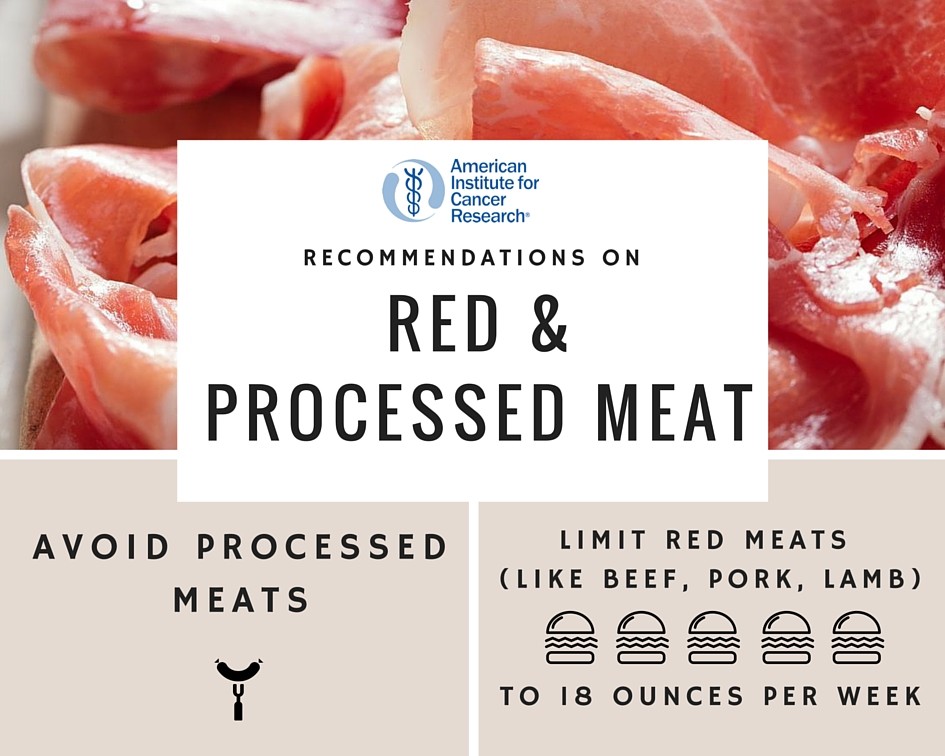
So what exactly is “processed meat”?
AICR defines processed meat as:
“meat preserved by smoking, curing or salting, or addition of chemical preservatives.” Ham, bacon, pastrami, sausages, hot dogs and cold cuts are all considered processed meat.
IARC’s definition:
“meat that has been transformed through salting, curing, fermentation, smoking, or other processing to enhance flavor or improve preservation. Most processed meats contain pork or beef, but processed meat may also contain other red meats and poultry”

Grilling burgers and hot dogs
It’s not yet clear exactly why these meats increase risk for colorectal cancer. It may be the added nitrites and nitrates, the smoking and/or high temperatures used in some processing, or the heme iron in red meat.
Does this include nitrate and nitrite free meats and sausage? These products are relatively new, so we need more studies that make these distinctions.
So, for now, save processed meats for special occasions and choose fresh meats most of the time. Here are some ideas to lower your cancer risk:
IARC has also listed red meat as a probable carcinogen. AICR’s recommendation for red meat is to keep your red meat to less than 18 ounces (cooked) per week. That’s about 4 hamburgers (quarter-pounders) weekly.here
Health Benefits
